
What Kind of Router Is Best For Me?
A Complete Guide to Choosing the Right Router
NETWORK
Posted by Tae K.
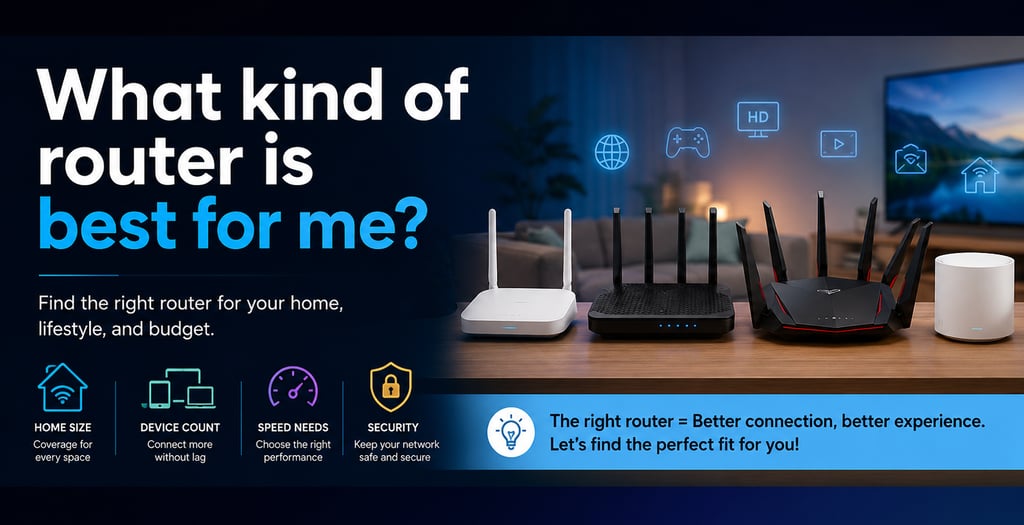
What Kind of Router Is Best for Me?
A Complete Guide to Choosing the Right Router
In today's digital world, a reliable internet connection is no longer a luxury—it's a necessity. Whether you're working remotely, streaming 4K movies, attending online classes, gaming competitively, or managing a smart home, your router serves as the heart of your network. Yet many consumers still find themselves asking a simple but important question: What kind of router is best for me?
The truth is that there is no single "best" router for everyone. The ideal router depends on your home's size, the number of connected devices, your internet speed, and how you use the internet on a daily basis. Understanding these factors can help you choose a router that delivers excellent performance without overspending.
Why Your Router Matters
Many people assume that internet speed depends entirely on their Internet Service Provider (ISP). While your ISP plays an important role, your router can significantly affect your online experience.
A poor-quality or outdated router can lead to slow speeds, weak Wi-Fi signals, buffering videos, dropped video calls, and frustrating dead zones throughout your home. On the other hand, a high-quality router can maximize your internet connection and provide a stable, fast, and secure network.
Types of Routers Available Today
1. Standard Wireless Routers
A standard wireless router is the most common choice for homes and apartments. These routers are designed to provide internet access throughout a moderate-sized living space and are generally affordable and easy to install.
A standard router is ideal if:
You live in a small apartment or house
You have fewer than 15 connected devices
You primarily browse the web, stream videos, and use social media
You want an affordable networking solution
For many households, a modern Wi-Fi 6 router offers more than enough performance for everyday use.
2. Mesh Wi-Fi Systems
If you live in a larger home, you may have experienced Wi-Fi dead zones where the signal becomes weak or disappears entirely. This is where mesh Wi-Fi systems shine.
Unlike traditional routers, mesh systems use multiple units called nodes. These nodes work together to create one seamless network that provides strong coverage throughout the entire property.
Mesh Wi-Fi is ideal if:
Your home exceeds 2,500 square feet
You have multiple floors
You experience weak signals in certain rooms
You use many smart home devices
Although mesh systems are typically more expensive, they offer superior coverage and convenience.
3. Gaming Routers
Gaming routers are designed for users who demand maximum performance. They often feature powerful processors, advanced traffic management, dedicated gaming modes, and low-latency optimization.
These routers are best suited for:
Competitive online gamers
Twitch streamers
Content creators
Households with heavy internet usage
If gaming is a serious hobby or profession, investing in a gaming router may be worthwhile.
Understanding Wi-Fi Standards
When shopping for a router, you'll likely encounter terms such as Wi-Fi 5, Wi-Fi 6, Wi-Fi 6E, and Wi-Fi 7.
Wi-Fi 5 (802.11ac)
Wi-Fi 5 remains common in many homes and still provides solid performance. However, it is gradually being replaced by newer technologies.
Wi-Fi 6 (802.11ax)
Wi-Fi 6 is currently the most popular standard. It offers:
Faster speeds
Better performance with multiple devices
Improved battery life for connected devices
Reduced network congestion
For most households, Wi-Fi 6 provides the best balance between performance and cost.
Wi-Fi 6E
Wi-Fi 6E introduces the 6 GHz frequency band, allowing devices to communicate on less crowded channels. This can significantly improve performance in busy households.
Wi-Fi 7
Wi-Fi 7 is the newest generation of wireless networking technology. It offers extremely high speeds, lower latency, and better efficiency. While impressive, Wi-Fi 7 routers are often expensive and may be unnecessary for average users.
How Many Devices Do You Have?
The average household today has far more connected devices than ever before. Smartphones, laptops, tablets, smart TVs, gaming consoles, security cameras, smart speakers, and smart appliances all compete for bandwidth.
As a general rule:
1–10 devices: Basic Wi-Fi 6 router
10–30 devices: High-performance Wi-Fi 6 or Wi-Fi 6E router
30+ devices: Premium router or mesh system
The more devices connected simultaneously, the more important router performance becomes.
Security Features You Shouldn't Ignore
Cybersecurity should be a top priority when choosing a router. Modern routers often include valuable security features such as:
WPA3 encryption
Automatic firmware updates
Built-in firewall protection
Guest networks
Parental controls
Device monitoring tools
These features help protect your personal information and reduce the risk of cyberattacks.
How Much Should You Spend?
Router prices vary widely depending on features and performance.
Budget routers ($50–$100) are suitable for light users and small apartments.
Mid-range routers ($100–$250) offer excellent value and meet the needs of most families.
Premium routers and mesh systems ($250–$600+) provide advanced performance, wider coverage, and future-proof technology.
While it may be tempting to buy the cheapest option available, investing in a quality router often leads to better performance and fewer connectivity issues over time.
Final Thoughts
Choosing the best router is about matching the technology to your lifestyle. If you live in a small apartment and use the internet primarily for streaming and browsing, a standard Wi-Fi 6 router is likely all you need. Larger homes may benefit from a mesh Wi-Fi system, while gamers and power users should consider performance-focused routers with advanced features.
Before making a purchase, evaluate your home's size, internet usage habits, number of connected devices, and future networking needs. By doing so, you'll find a router that delivers fast, reliable, and secure internet access for years to come.
Ultimately, the best router is not necessarily the most expensive one—it's the one that fits your specific needs and helps you stay connected without compromise.
Contact Us
Get in touch with us
Phone Number:
info@primetechcarelv.com
© 2025. All rights reserved.
Address:
Email: